
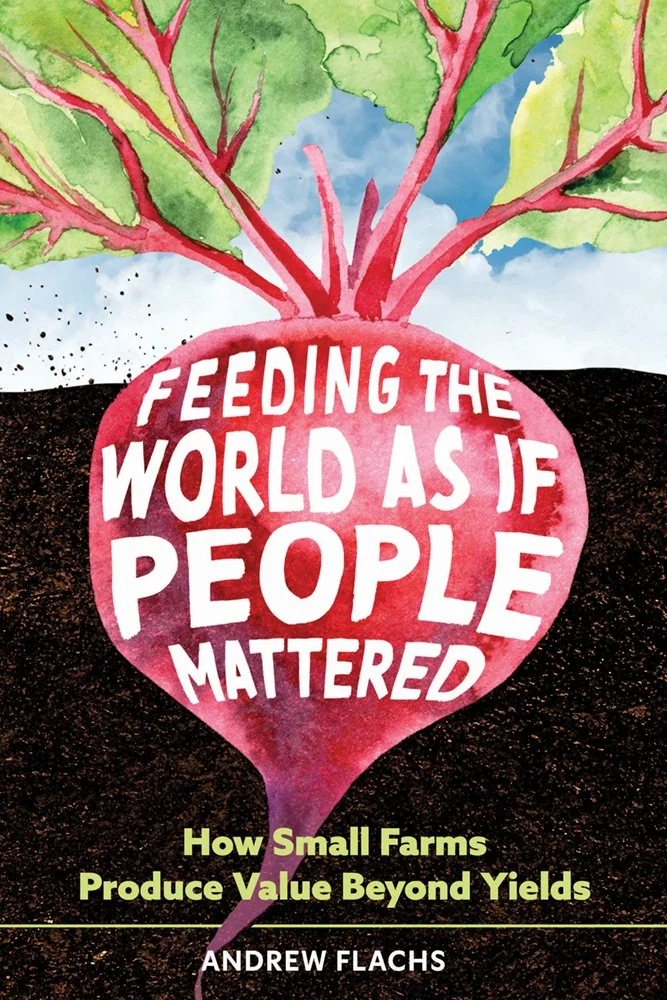
The dominant view of agriculture has focused only on what we produce. It sees value in terms of capital gains or yield efficiency, masking how our global food system produces tremendous amounts of food commodities while failing to feed people, support rural communities, or enhance ecological well-being. Feeding the World as if People Mattered asks us to look more deeply and more humanely at what we perceive to be most valuable in our agricultural systems.
This book draws on fifteen years of anthropological research, taking readers to fields in South India, Eastern Europe, and North America, where people are already feeding the future amid global change. From these fields, this book shows us how a radical rethinking of the value of small farms and farmers is already happening. Bringing together conversations in agriculture, economics, anthropology, and the environmental humanities, this book deftly shows how small farms reproduce social and ecological relationships that are the only sustainable path forward.
Ethnobiology and Degrowth: Allied fields in a complex world
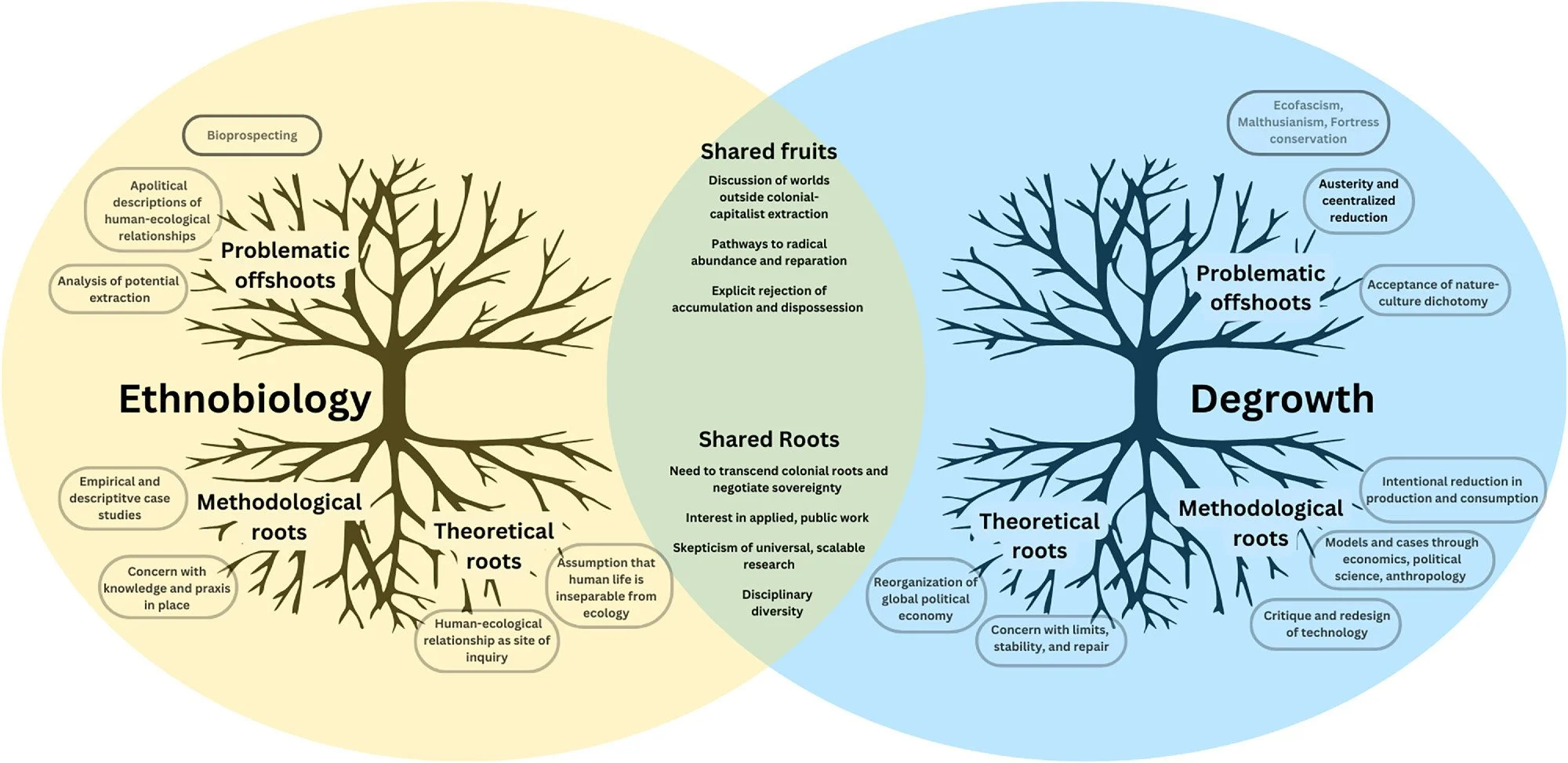
Ethnobiology offers meticulous case studies into the web of life, neither studying life apart from human influence nor centering its intersection with humans. While we work in a world shaped through colonial hierarchies and capitalist extraction, we rarely center this context in our research. Degrowth research offers a vocabulary to contribute to larger discussions of political economy and political ecology. It tends to emphasize political economy and industrial relations, centering/combatting capitalism while glossing the fine details of how communities co-create environments.Both conversations work to transcend problematic histories: ethnobiology opposes extraction and appropriation, while degrowthers reject Malthusian and ecofascism. But as long as these inform public conversations around human–ecological relationships and downscaling, the work is never finished.If the point of our work is not just to interpret the world in various ways but to change it, then ethnobiology and degrowth scholars are allies in action-oriented, imaginative research. Both ask how to scale up reciprocity and care. This is a way of being, a relationship. It is not a product.
Flachs, Andrew and Ashley Glenn. 2025. “We are just surviving:” The paradox of robust homegardens in Northern Bosnia and Herzegovina. East European Politics and Societies. 39(4): 1001-1018. https://doi.org/10.1177/08883254251394653.
Flachs, Andrew. 2025. “Ethnobiology and Degrowth.” Journal of Ethnobiology. https://doi.org/10.1177/02780771251374886
Flachs, Andrew. 2022. “Degrowing alternative agriculture: institutions and aspirations as sustainability metrics for small farmers in Bosnia and India.” Sustainability Science. 17(1):2301-2314. https://doi.org/10.1007/s11625-022-01160-9.
Flachs, Andrew and Glenn Davis Stone. 2019. “Farmer Knowledge Across the Commodification Spectrum in Telangana, India.” Journal of Agrarian Change, 19(4):614-634.
Efficiency Paradoxes
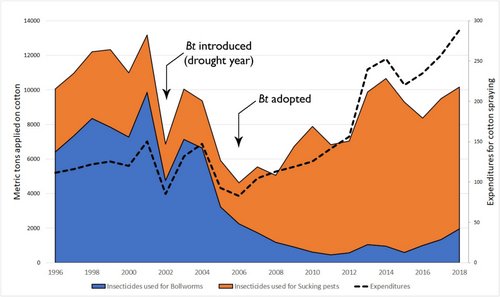
Thirty years on, GM crops encounter the Jevons paradox: initial efficiencies in pesticide use have led to massive increases in those pesticides . While individual farms can spray less, at first, this allows more people to plant more land and thus spray more. But, farms are ecological systems too. Initial "efficiencies" in spraying lead to new niches meaning new and different spraying regimes as on Indian Bt cotton farms. The expansion of these crop-chemical regimes takes place in a context where herbicides, especially glyphosate, are getting cheaper and facing pressure from a large generics market. Ultimately, the Jevons Paradox appears because a new efficiency makes something seem to be essential to the world, foreclosing other possible futures. Its not just that people spray more, its that spraying becomes a necessary part of agricultural work. This is a feature, not a bug of these systems.
Flachs, Andrew, Glenn Davis Stone, Steven Hallett, and K.R. Kranthi. 2025. “GM Crops and the Jevons Paradox: Induced Innovation, Systemic Effects and Net Pesticide Increases From Pesticide-Decreasing Crops.” Journal of Agrarian Change. https://doi.org/10.1111/joac.70006